Previous version of our website: old.vfu.bg/en


ASSOC. PROF. ELEONORA TANKOVA, PHD TO ECONOMY.BG: I DREAMED OF BEING WHERE CHANGE WAS HAPENING. IT TURNED OUT THAT THE UNIVERSITY IS EXACTLY SUCH A PLACE
21 August 2026
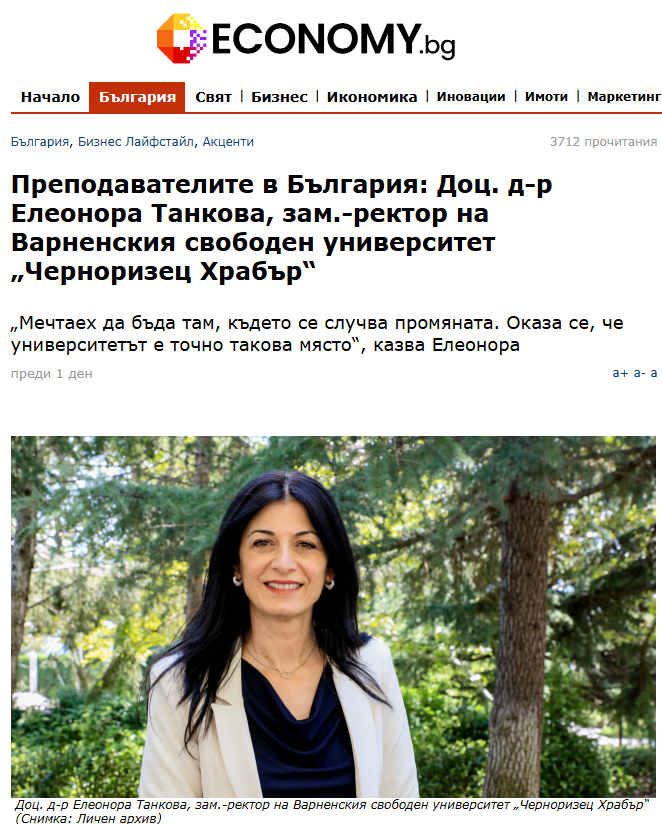 University teachers in Bulgaria: Assoc. Prof. Eleonora Tankova, PhD, Vice-Rector of Varna Free University “Chernorizets Hrabar”
In the section “University Teachers in Bulgaria”, Economy.bg presents teachers from leading universities in Bulgaria. We follow their professional path from the first steps to the lessons they themselves have learned. How do they overcome challenges, which stories of their students are they proud of and how do they see the future they build every day with their work?
Meet Assoc. Prof. Eleonora Tankova, PhD, Doctor of Economics and Associate Professor of Globalization of Development. Since 2023, she has been the Vice-Rector for Institutional Cooperation and Development of Varna Free University "Chernorizets Hrabar", and between 2013 and 2023 she was the Dean of the Faculty of International Economics and Administration.
Meet Assoc. Prof. Eleonora Tankova, PhD, Doctor of Economics and Associate Professor of Globalization of Development. Since 2023, she has been the Vice-Rector for Institutional Cooperation and Development of Varna Free University "Chernorizets Hrabar", and between 2013 and 2023 she was the Dean of the Faculty of International Economics and Administration.
She teaches disciplines in the field of global sciences.
How and why did you choose the field of education?
I did not have a preconceived plan that one day I would be a university teacher, dean or vice-rector. As a young person, I dreamed of being where change was happening. It turned out that the university was exactly such a place. I started with youthful energy and enthusiasm, and gradually the university became a big part of both my professional and personal life. Every year, hundreds of young people with different dreams enter the auditorium; they develop and build on at the university, so that in a few years they can graduate as architects, lawyers, entrepreneurs or leaders. Being a witness to this transformation is a huge privilege. My professional path has been connected with Varna Free University since its establishment in 1991. Back then, it was a new place, born from the strong desire to create a different educational model – freer, more open to the world and closer to changes in society. And so it has been for 35 years.
How would you describe today's students?
Years ago, students came to university to gain access to knowledge. Today, the sources of knowledge are many and varied. Now students come for something much more valuable – to learn how to distinguish what is important, how to think critically and how to work with other people. Today's students are informed, demanding, inquisitive and active. Their horizon is much more global. They have access to a huge amount of information, follow processes from different parts of the world, compare educational and professional opportunities and make their choices more and more consciously. They ask questions and expect to understand the practical value of what they learn.
This is a generation that values the freedom to express their position and expects to be heard. Young people value open conversation, quick feedback and a partnership. They perceive the teacher as someone who can help them navigate the complex environment, discover their strengths and turn their ideas into real projects.
It strikes me that over the years they become more and more excited about public causes, raise new topics, propose solutions and often initiate significant initiatives. When they gain trust and space for action, they show creativity, commitment and willingness to take responsibility for the implementation of their ideas.
The Student Council of Varna Free University is an excellent example of this. It is an extremely strong and active organization that is the basis of many of the events. One of the clearest examples is the creation of the National Competition in Criminal Law, which is being held for the second consecutive year and brings together the best law students from universities across the country. Equally significant are the charitable and volunteer initiatives through which students change the environment in family-type accommodation centres and create lasting relationships with the children and youth who live there.
Do you observe differences between today's students compared to previous generations?
The differences are natural, because each generation is formed in a different social, economic and technological environment. The first students of Varna Free University were the young people of change. They were looking for a new educational model and the opportunity for free expression, entrepreneurship and development.
Today's students are growing up in a connected world. They perceive information faster, prefer interactive forms and expect an active connection between theory and practice. It is important for them to know not only what they are learning, but also why they are learning it and where they can apply what they have learned. This requires the teacher to create context, encourage discussion and provoke students to be active participants.
How does one of your lectures run? Has your teaching style changed over the course of your professional experience?
At the beginning of each year, I tell my students: “Don’t expect to write down everything I say. I expect to discuss and argue.” I have been teaching courses in the field of global studies for over 20 years. The very essence of this subject involves talking about processes that are developing before our eyes and affect us all – economic, social, technological and environmental changes. A lecture cannot be just a one-way transmission of theory and data. When we discuss artificial intelligence, environmental problems or trade conflicts between the US and China, no one has ready-made answers. Therefore, the goal is not to memorise facts, but to learn to ask the right questions and understand the reasons that led to the complex and uncertain global environment in which we live. I strive to put up case studies for discussion, to present different points of view and to encourage students to analyse the causes and consequences of global processes.
Over the years, my teaching style has naturally changed. Today, I believe much more in active learning, discussion, and working on real projects that connect knowledge with practice. The role of the teacher is now to help students formulate the right questions, evaluate their sources, and build a reasoned position.
What are the biggest challenges facing lecturers today?
Twenty years ago, the teacher was one of the main sources of knowledge. Today, knowledge is just a click away. This means that our role is changing. We are increasingly the ones who help students distinguish facts from opinions, reliable information from manipulation, and build their own reasoned position. The challenge is that we live in a time when information is becoming cheaper and the ability to think is increasingly valuable.
Another big challenge is the speed of change. Professions are transforming faster than universities have traditionally updated their curricula. We are increasingly preparing students for professions that do not yet exist in their current form. This means that in addition to professional knowledge, we must develop adaptability, resilience, the ability to learn throughout life, teamwork, and the ability to make decisions in conditions of uncertainty.
There is another challenge that is less often talked about. Today, young people live in a world of constant crises – pandemics, wars, economic uncertainty, climate change, technological revolutions. They expect the university not only to prepare them for a profession, but also to help them navigate an increasingly complex world. Therefore, the teacher must be a good specialist, but also a person who inspires confidence, encourages dialogue and shows that complex problems can be solved with arguments, knowledge and cooperation.
And last but not least, the challenges are not only in the classroom. They are also related to the environment in which universities operate. Bulgarian higher education needs fair and equal competition, based on quality, results and student trust. Universities should compete with ideas, innovations and quality of education, not with different rules and different funding conditions. Ultimately, the most important question is not which university is public or private, but which one succeeds in preparing young people for the life and professions of the future.
What are the most valuable skills to be a good teacher?
A good teacher must be willing to learn throughout their life. The ability to listen, communicate clearly, show empathy and recognise the potential of students is important.
They also need to be able to connect theory with the real world and create an environment in which students have the courage to ask questions, express different opinions and experiment. Teaching requires consistency and high standards, but also the ability to inspire. Young people sense when a teacher believes in the meaning of what they are doing.
How do you assess the level of cooperation between universities and employers in Bulgaria?
In recent years, cooperation between universities and employers in Bulgaria has been visibly developing, but it is still uneven. There are many good examples, but there are also partnerships that remain mainly at the level of signed agreements, guest lectures or short-term internships. In my opinion, the best partnership between a university and a business begins when the employer stops asking “What kind of personnel will you give me?” but to ask “What can we create together?” At Varna Free University, we assess partnerships not so much by their number, but by the specific results for students and employers. This is precisely what full-fledged cooperation is – joint development of programmes, participation of practitioners in training, work on real cases, internships and professional opportunities while still studying.
The role of our alumni is particularly valuable. When former students return as employers, mentors or partners, they become a natural bridge between the academic and professional environment. They know both the strengths of university training and the real requirements of the workplace. Therefore, they can very precisely indicate what should be preserved and what should be changed.
How can the relationship between business and education be improved?
At our university, business is already involved in the creation and updating of curricula. Employers provide expertise, real-world assignments, mentors, internships, and feedback on the knowledge and skills they need.
A good working model is the branch boards of trustees, through which representatives of professional communities systematically participate in the development of training. Dual training also provides opportunities. Varna Free University “Chernorizets Hrabar” has expressed its readiness to develop such a model in the specialties Civil Engineering and National Security Protection.
It is especially important for students to work on real professional tasks during their studies. Law students resolve cases with sitting magistrates; students are present in the courtroom during the consideration of cases of public interest and participate in simulated trials. Architecture students develop real investment projects for the Industrial Park in Shumen. They also created projects for shared spaces at the “Nikola Yonkov Vaptsarov” Naval Academy.
Our university also assigns students real tasks on a competitive basis. One of the most visible results of this approach is the university park, which originated from 2012 student projects. This year, students of the Interior Design major will work on a real task related to specialised spaces of one of the judicial institutions in Varna. Such projects allow young people to go through the entire professional process – from researching and developing the concept to presenting it to a real client.
Experience shows that systematic partnerships yield measurable results. Over 2,400 students participated in the first two phases of Student Placements Project of the Ministry of Education and Science. Of these, 95% indicated that they had acquired new practical skills, more than 70% believed that their university education had provided them with the necessary foundation for work in a real professional environment, and 17.3% received a job offer after completing their internship. This is a particularly important result because it shows that the link between education and employment can begin even before graduation.
For their part, universities can also be much more than a source of human resources – they can be partners in research, innovation and the development of organizations. The best results are achieved when cooperation is long-term, has measurable goals and is based on trust and shared responsibility.
Do you personally use artificial intelligence and for what purpose?
Artificial intelligence is already part of the environment in which universities, lecturers and students work. Therefore, it is important for me to know its capabilities, to monitor its development and to talk openly about the rules, ethical framework and responsibility for its use.
In an academic environment, every tool should support thinking, analysis and value creation, and be applied transparently, critically and with respect for academic ethics.
In your opinion, how might artificial intelligence benefit students?
AI can help students navigate large amounts of information, structure ideas, study languages, analyse data, and develop solutions. It can make learning more personalised, provide quick feedback, and free up time for deeper analysis and creativity.
However, its true value comes when students have the knowledge and analytical thinking needed to evaluate the results. That’s why we need to teach young people to check facts, recognise the capabilities and limitations of technology, account for when and how they’ve used it, and take personal responsibility for the end product.
Varna Free University “Chernorizets Hrabar” has developed an AI policy that regulates its ethical, transparent, and lawful use. Our understanding is that technology should support the quality of education and academic integrity, with the final judgment and responsibility remaining human.
I am not afraid that students use artificial intelligence. I am afraid that they will stop thinking critically, because artificial intelligence can write a good text, but it cannot take moral responsibility for it. This is and will be a human task. Instead of limiting access to new technologies, we must prepare students to use them competently and honestly. Artificial intelligence is a good helper when it stimulates curiosity, develops the ability to make independent judgments and expands learning opportunities. It is these skills that will be increasingly important for the professional realization of young people.
What is needed to prepare students for the professions of the future?
First of all, we need to prepare them for change. Some professions will transform, others are yet to emerge. Therefore, along with professional knowledge, adaptability, resilience, excellent digital literacy, teamwork, communication skills and the ability to solve complex problems are needed.
Curiosity, caring for others and responsibility to the community are also important. The future will need competent people who understand the consequences of their decisions. Project-based learning and work on real tasks allow these qualities to be developed already at university.
Do you have a favorite story about your students that you are proud of, or a story about students who have achieved success?
It is difficult for me to single out one student or one story. In 35 years, Varna Free University has built a community of 48,000 alumni, who have achieved success in various professional areas and in many countries around the world. One of the best moments for any professor is when, after years, a former student knocks on the door. They come as employers, as partners, or as someone who want to help the next generation. Then you understand that university does not end with graduation. Yes, this is my favorite story – students who return to their alma mater!
How do you like to spend your free time?
I love the mountains, I love nature and sports. This is my way to restore my energy and organise my thoughts. I read a lot, because for me reading is both a pleasure and a way to continue discovering new perspectives. Time with family and friends is valuable to me. In a daily life filled with many meetings and responsibilities, movement, nature, books and time with my loved ones bring me the necessary balance.